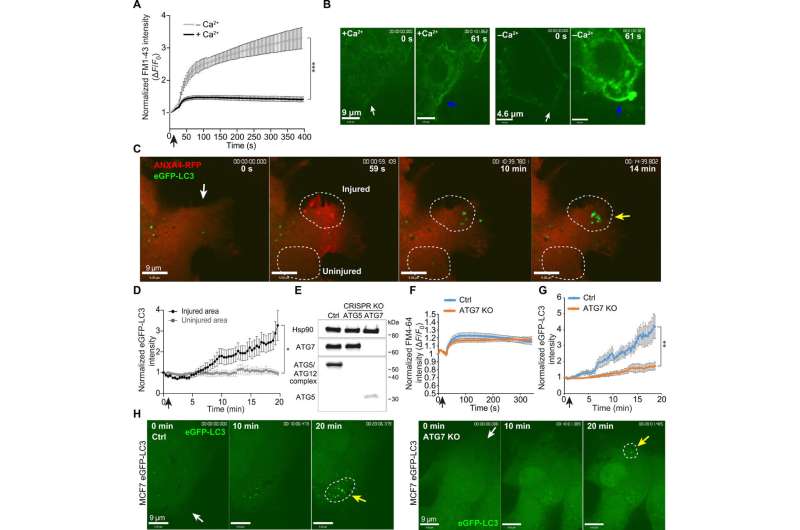
图1激光损伤导致ATG7-dependent LC3-positive囊泡的形成在质膜修复区域。(一)MCF7细胞受伤的烧蚀激光介质有或没有Ca2 +。均值±SEM的规范化FM1-43细胞质染色水平,11细胞每三个实验条件,P < 0.0001 (AUC分析,未配对t检验与威尔士的修正)。黑色箭头,受伤时间点。(B)代表图像FM1-43强度MCF7细胞受伤Ca2 +包含介质(左)和Ca2 +缺陷介质(右)之前和之后的伤害(61年代),白色箭头,受伤的网站。蓝色箭头指向FM1-43染料积累。(C)代表序列的图像ANXA4-tRFP-transfected MCF7 eGFP-LC3细胞暴露于激光损伤。黄色箭头,LC3 puncta形成。白色的圆圈,eGFP-LC3量化。也看到电影S1。 (D) eGFP-LC3 intensity after laser injury in injured areas compared to control. Fifteen individual cells from three experiments (mean ± SEM, paired t test of AUC values). Black arrow, injury time point. (E) Immunoblot for ATG7, ATG5, and the ATG5/ATG12 complex (Hsp90, loading control) of lysates from MCF7 eGFP-LC3 CRISPR KO cells: nontargeted control, ATG5 CRISPR KO, and ATG7 CRISPR KO. (F) Cell membrane repair kinetic upon laser injury in ATG7 CRISPR KO and Ctrl cells as measured by FM4-64 cytoplasmic dye levels from 11 cells per cell line (from three experiments). Mean ± SEM. Black arrow, injury time point. (G) Analysis of eGFP-LC3 intensity at the injury site in MCF7 ATG7 CRISPR KO and Ctrl cells (mean ± SEM, 16 cells from three experiments per cell line, unpaired t test of AUC values, Welsh’s correction). (H) Representative sequential images of eGFP-LC3 puncta formation in Ctrl (left) and in ATG7 CRISPR KO cells (right) after laser injury. White arrows indicate injury sites, yellow arrows indicate area of LC3 puncta formation, and white circles indicate the area used for eGFP-LC3 quantification. *P ≤ 0.05; **P ≤ 0.01; ***P ≤ 0.001. Credit: DOI: 10.1126/sciadv.abg1969