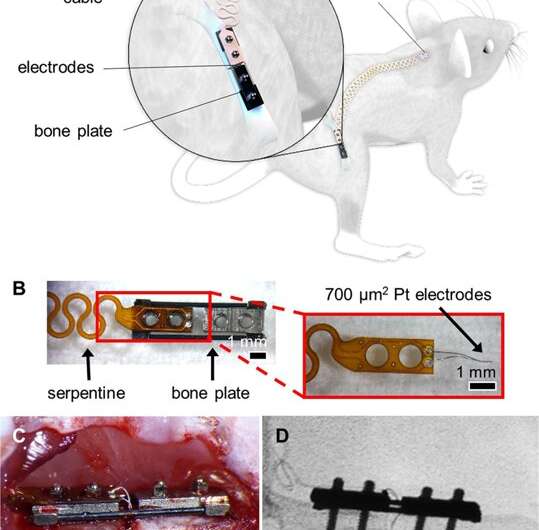
外固定架模型的系统概述和传感器。(A)在小鼠胫骨骨折中嵌入传感器的系统概述,其中损伤用外固定架稳定。由Ella Maru工作室创建的图像。(B) 0.25 mm直径的传感器制作在FR4衬底上,带有金(Au)表面电极和腿外连接到测量硬件的大通孔。将传感器植入有0.5 mm和2 mm缺陷的外固定小鼠胫骨。(C)在外固定架模型中植入0.25 mm传感器的开放式手术照片。放置传感器后闭合手术部位。(D)在2mm缺陷处植入0.25 mm传感器的透视图像。(E) 56微米直径的传感器,使用铂(Pt)线组装,记录位置由CO2激光器和线圈暴露,以提供应变缓解。(F)在外固定架模型中植入56微米传感器的开放式手术照片。 Surgical site was closed following sensor placement. (G) Fluoroscopy image of implanted 56 µm sensor in a 0.5 mm defect. Credit:科学报告, doi: https://doi.org/10.1038/s41598-018-37784-0
在外固定架模型中,阻抗数据区分愈合和愈合不良的胫骨骨折。组织学切片用Hall’s和brent’s四重染色(HBQ)染色,假染色以帮助解释组织组成。蓝色=软骨,黄色=小梁骨,紫色=纤维/无定形组织。原始红色=皮质骨,黑色/白色区域=骨髓。(A)骨折后14天外固定0.5 mm缺损的代表性组织学切片;骨折间隙被软骨和新的小梁骨明显地连接起来。(B)骨折后14天外固定2mm临界尺寸缺损的代表性组织学切片;骨折间隙以纤维组织为主。(C)用250µm传感器测量的15 kHz电阻(R)在骨折后几天内绘制,用于测量0.5 mm (N = 6)和2 mm (N = 5)缺陷的小鼠。线性回归分析表明,0.5 mm缺陷小鼠与肿瘤间存在显著正相关(p < 0.0001),而2mm缺陷小鼠与肿瘤间无相关关系。 (D) Representative histology section for a healing mouse at 28 days post-fracture; the fracture gap is clearly bridged by cartilage and new trabecular bone. (E) Representative histology section for a poor-healing mouse at 28 days post-fracture; the fracture gap contains an overabundance of fibrous tissue. (F) Black arrow points to 56 µm sensor fully embedded in fracture tissue. (G) Electrical resistance (R) and reactance (X) normalized as a ratio to day 4 plotted over the course of fracture healing at 15 kHz. Normalized R and X both rise steadily over healing time in the healing mice, with stagnant values observed in the poor-healing mice. (H) Normalized R and X as a ratio to day 4 plotted over a range of frequencies at day 7 post-fracture. (I) Normalized R and X as a ratio to day 4 plotted over a range of frequencies at day 28 post-fracture. Marked shifts in frequency response from day 7 were observed in the healing mice, with limited change occurring in the poor-healing mice. Credit:科学报告, doi: https://doi.org/10.1038/s41598-018-37784-0
在骨板模型中,阻抗数据将股骨骨折完全愈合与愈合程度不同的骨折区分开来。组织学切片照常染色、假色。(A)愈合良好的小鼠第26天的代表性组织学切片;一个大骨痂完全连接骨折两端。(B) (B) (A)高倍镜图像,黑色箭头指向电极完全融入新骨小梁。(C) (A)样品的x光片。(D) (A)样品的表面渲染,三维µCT图像。(E) 26天混合愈合的小鼠代表性组织学切片;骨折愈伤组织包括软骨、纤维组织和骨小梁。(F) (F) (E)的高倍镜图像,黑色箭头指向完全嵌入骨痂的电极,周围是新生骨小梁和纤维组织的混合物。(G) (E)中样品的x射线片。(H)表面渲染,(E)中样品的三维µCT图像。(I) R(归一化为与第2天的比率)在骨折后几天以15 kHz绘制。数据标记和线条根据愈合程度着色——红色阴影代表第12天牺牲的小鼠(F1, F2, F3),蓝色阴影代表第26天牺牲的愈合良好的小鼠(F4, F5, F6),紫色阴影代表第26天牺牲的愈合不良的小鼠(F7, F8),棕色阴影代表第26天牺牲的对照组小鼠(C1, C2)。 Normalized R clearly rises at a faster rate in two mice with complete bony calli, F4 and F5. (J) X (normalized as a ratio to day 2) at 100 kHz plotted over days post-fracture. Normalized X clearly rises at a faster rate in two mice with complete bony calli, F4 and F5. (K) Impedance data at all measured frequencies is fit to an equivalent circuit model (inset), and the R2t parameter is extracted, normalized as a ratio to day 2, and plotted over days post-fracture. This analysis is able to clearly distinguish the samples that are classified as union by orthopaedic surgeons. Credit:科学报告, doi: https://doi.org/10.1038/s41598-018-37784-0


用户评论